
$16.3 billion in revenue is projected to be lost by 2025 because end-to-end healthcare revenue cycle management is still handled as a chain of disconnected tasks instead of a single financial system, according to the Council for Affordable Quality Healthcare. That should get every hospital CFO’s attention.
Most organizations still treat the revenue cycle like an operations problem. It isn’t. It’s a balance-sheet problem, a cash-flow problem, a margin problem, and a governance problem. If patient access, coding, claims, denials, and collections sit in separate silos with separate owners and separate technologies, your organization is leaking revenue every day.
The end-to-end healthcare revenue cycle should be managed like any other strategic asset. You wouldn’t run treasury, procurement, or capital planning through fragmented spreadsheets and handoffs, then act surprised when cash gets trapped. RCM deserves the same discipline. One operating model. One data spine. One set of executive metrics. One accountability structure.
Why Mastering Your Revenue Cycle Is Non-Negotiable
A hospital can deliver excellent care and still underperform financially if its revenue cycle is fractured. That’s the blunt reality. Margin erosion often starts long before a claim is denied. It starts when scheduling captures incomplete demographics, when eligibility isn’t verified correctly, when authorizations stall, when coding lags, and when finance teams see the damage only after A/R is already bloated.
The problem isn’t that hospitals lack effort. The problem is that too many leaders still classify RCM as a back-office function. That mindset is expensive. Revenue cycle performance shapes liquidity, staffing flexibility, investment capacity, and how much disruption your organization can absorb when payer behavior changes.
A modern CFO should treat the end-to-end healthcare revenue cycle as a managed financial engine, not a loose federation of billing tasks. That means operational decisions at the front end must be judged by downstream financial impact. Registration accuracy, documentation discipline, and denial prevention aren’t departmental concerns. They’re enterprise finance levers.
For a useful framing, see why RCM is not a back-office function. It aligns with what strong finance leaders already know. Revenue integrity is built across the full patient financial journey, not recovered at the end through heroic cleanup.
What CFOs should change immediately
- Stop managing by department: If patient access, HIM, billing, and denials report performance separately, you’ll miss the root cause.
- Tie cash goals to process ownership: Every major revenue KPI should map to a named operational leader, not just finance.
- Demand one narrative: Your teams should explain revenue variance through workflow performance, not anecdotes.
- Treat denials as design failures: Most denials aren’t random. They’re evidence that upstream controls are weak.
Practical rule: If your organization discusses RCM mainly in terms of staffing volume, vendor tickets, and late-stage collections, you’re already managing too low in the value chain.
Hospitals that win on revenue cycle don’t just bill faster. They design a system that protects revenue from the first patient touch through final payment.
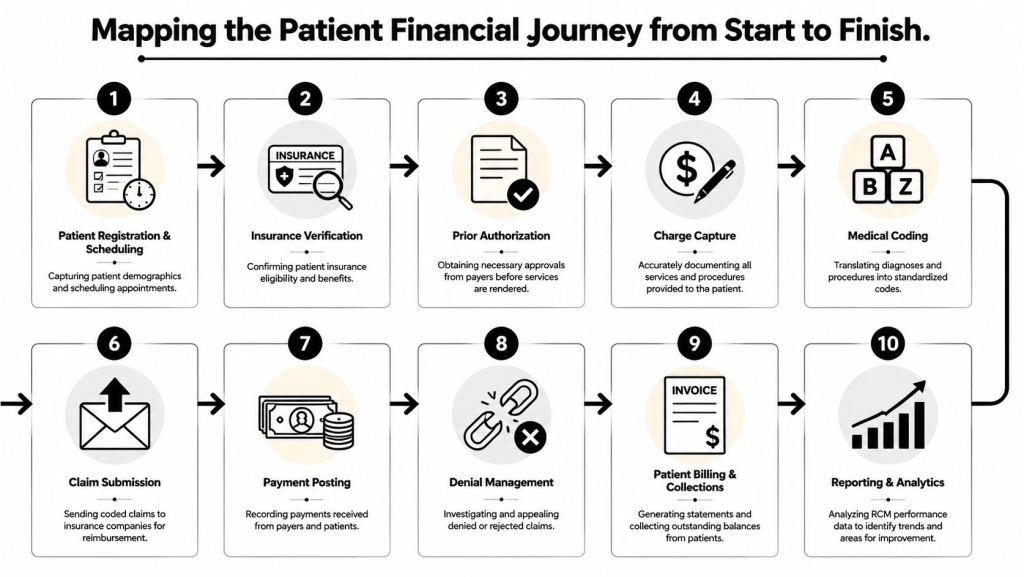
Mapping the Patient Financial Journey from Start to Finish
The cleanest way to understand the end-to-end healthcare revenue cycle is to follow the patient’s financial journey. Every handoff either preserves reimbursement or degrades it. By the time a claim is denied, the underlying failure often happened much earlier.
Front end sets the revenue trajectory
The first phase includes scheduling, registration, insurance verification, and prior authorization. Many health systems still underestimate how much financial risk sits here. That’s a mistake because front-end defects multiply downstream.
Optimizing patient registration and insurance verification can reduce downstream denials by up to 75%. That’s why patient access deserves more executive scrutiny than it usually gets. If the data entering the system is incomplete or inaccurate, every downstream team spends time correcting avoidable errors instead of advancing cash.
A useful perspective is in powering the patient experience through front-end RCM. Front-end financial work isn’t just administrative. It shapes reimbursement accuracy and patient trust at the same time.
Mid-cycle is where documentation becomes money
The middle of the cycle is where clinical activity gets converted into billable, compliant, payable claims. This includes charge capture, documentation review, coding, and claim preparation. A lot of hospitals underinvest here because it feels technical and specialized. They shouldn’t.
If charge capture is late, coding is inconsistent, or edits are weak, you create avoidable delays and rework. Worse, you force the back end to chase payments on claims that were flawed before submission. That’s not denial management. That’s denial manufacturing.
Three common mid-cycle breakdowns usually drive outsized financial damage:
- Delayed charge capture: Revenue sits unbilled while A/R pressure builds.
- Coding inconsistency: Underpayments, denials, and compliance exposure follow.
- Weak edit logic: Claims go out with defects that should’ve been caught before submission.
Mid-cycle discipline is where clinical documentation, coding accuracy, and compliance stop being abstract concerns and become cash outcomes.
Back end determines how much of earned revenue you actually keep
This phase includes claim submission, payment posting, denial management, patient billing, and collections. Most organizations focus here because the signs of trouble become apparent. Cash is late. Denials are piling up. Patient balances are aging.
But the back end can’t compensate forever for broken upstream workflows. It can only recover part of what the organization failed to protect earlier. Strong back-end teams do matter. They identify payer behavior, pursue underpayments, appeal denials, and improve patient collections. Still, they’re most effective when they operate inside an integrated system rather than as a rescue squad.
Reporting closes the loop
The cycle doesn’t end with payment. It ends when leadership can connect outcomes back to root causes. Reporting and analytics should answer practical questions:
- Where does cash stall?
- Which defects create the most rework?
- Which payer patterns require operational changes?
- Which patient access errors recur by facility, specialty, or team?
That’s how a CFO turns the end-to-end healthcare revenue cycle into a controllable asset. Not by watching isolated tasks, but by managing the full financial journey as one linked system.
Measuring What Matters Most in Your Revenue Cycle
Most executive RCM dashboards are too crowded to be useful. If everything is a priority, nothing is. A CFO needs a short list of metrics that expose cash friction, revenue leakage, and operational discipline.
The first metric I look at is Days in Accounts Receivable. It cuts through noise. Days in A/R is benchmarked at 30 to 40 days for optimal cash flow, and practices exceeding 50 days often face strained liquidity. When that number drifts up, don’t ask only what billing is doing. Ask where the workflow broke before the bill ever went out.
The KPI table that actually matters
| KPI | Industry Benchmark | What It Measures |
|---|---|---|
| Days in A/R | 30 to 40 days | How quickly the organization converts receivables into cash |
| Days in A/R warning threshold | Over 50 days | Whether billing, follow-up, or collections delays are impairing liquidity |
| Net Collection Rate | Above 95% | How much of the contractually allowed reimbursement the organization actually collects |
| Patient Payment Collection Rate | Above 95% within 120 days | How effectively the organization converts patient-responsibility balances into cash |
| Denial Rate | Below 5% | How often claims fail because of process, documentation, authorization, or payer issues |
| Clean Claim Rate | Qualitative benchmark only | Whether claims are accurate enough to be paid on first pass without rework |
| Pre-Authorization Success Rate | At or above 95% | How reliably the organization secures approvals before service |
| Cost to Collect | Below 3% to 4% | How efficiently the organization converts earned revenue into collected cash |
What these numbers tell you
Days in A/R is your broad operating signal. It won’t tell you the exact defect, but it tells you the financial system is slowing down. Net Collection Rate answers a sharper question. Are you collecting what you earned after contractual adjustments? If that metric slips, look hard at denials, underpayments, and unresolved follow-up.
Denial rate is the pressure test for process quality. If it’s high, the organization is usually tolerating preventable defects somewhere between access and submission. Patient payment collection rate matters more now because the hospital’s financial exposure doesn’t stop with the payer. It extends into the patient balance, and that requires clear estimates, accurate statements, and disciplined follow-up.
Board-level takeaway: A healthy revenue cycle doesn’t just collect cash. It predicts cash, protects cash, and explains cash.
What to avoid in executive reporting
- Don’t accept blended metrics with no drill-down: Systemwide averages hide facility-level and service-line problems.
- Don’t separate finance from operations: Every KPI should trace to a workflow.
- Don’t review metrics without action thresholds: A dashboard without trigger points is decoration.
If your KPI set doesn’t help leaders decide where to intervene this week, it isn’t an executive dashboard. It’s a status report.
How AI and Automation Are Transforming RCM
Technology in RCM has moved past workflow convenience. It’s now about financial control. The end-to-end healthcare revenue cycle generates too many transactions, exceptions, edits, payer rules, and documentation dependencies for manual management to scale cleanly.

Integrated RCM investments have shown a 310% three-year ROI and an average 25-day reduction in A/R when analytics are used to prevent denials and optimize workflows. CFOs shouldn’t read that as a technology story. They should read it as a capital allocation story. If a platform materially improves cash conversion and reduces rework, it belongs in the same strategic conversation as any other enterprise investment.
What automation should actually do
Too many vendors talk about AI in abstract terms. Don’t buy abstractions. Buy outcomes tied to specific workflow failures.
- AI for denial prevention: Models can flag claim risk before submission so teams fix errors upstream.
- ML for coding support: Pattern recognition improves coding consistency and surfaces documentation gaps.
- RPA for repetitive tasks: Eligibility checks, authorizations, reconciliation steps, and follow-up routing don’t need human hands every time.
- Unified analytics for control: Leaders need one view of access, coding, billing, denials, and collections to act fast.
For a grounded look at the operating shift, read how AI is transforming healthcare revenue cycle management. The gain isn’t novelty. It’s decision speed and process reliability.
Integration matters more than feature lists
A fragmented tech stack can automate individual tasks and still fail financially. If eligibility, coding, claims, and analytics live in separate systems with weak data exchange, your teams end up managing exceptions manually anyway. That defeats the point.
This is where integrated platforms matter. GeBBS Healthcare Solutions, for example, uses tools such as iCodeONE and iCareONE alongside RPA and analytics-driven workflows to support coding, denials, and broader revenue operations. That kind of architecture is more relevant than a long feature checklist because it connects automation to operating accountability.
A short explainer is worth watching if you’re evaluating where AI fits into a broader modernization plan:
The CFO test for any RCM technology
Ask four direct questions before approving anything:
- Does it reduce preventable denials before they occur?
- Does it shorten the time from service to clean claim submission?
- Does it give finance and operations one shared performance view?
- Does it integrate with the systems your teams already depend on?
If the answer to any of those is no, the tool may help a department, but it won’t fix the revenue cycle.
Unlocking the True ROI of an Optimized Revenue Cycle
RCM ROI isn’t limited to one line item. It shows up in liquidity, labor efficiency, compliance, and management confidence. That’s why CFOs should stop asking whether an overhaul will “improve billing” and start asking how much enterprise value is trapped inside a broken process.

One of the biggest barriers to realizing that value is integration. Legacy EHR integration challenges can drive 30% to 50% of denials, and overcoming that obstacle is a major differentiator for outsourced, fully integrated RCM models that can reduce A/R days and accelerate cash flow (legacy integration and denial impact). That’s not a minor IT nuisance. It’s direct financial drag.
Financial return is the first layer
An optimized end-to-end healthcare revenue cycle improves working capital because cash moves with fewer delays and less rework. That matters to every CFO managing margin pressure, debt obligations, capital projects, and labor costs. Faster reimbursement creates room to operate. Slower reimbursement forces tradeoffs.
Financial return also shows up in revenue preservation. Fewer preventable denials, stronger underpayment follow-up, and tighter patient collections mean the organization keeps more of what it already earned. That’s a cleaner path to improvement than chasing volume.
Operational return is usually underestimated
When RCM runs well, teams don’t spend their day hunting for missing information, rebilling avoidable defects, or manually reconciling disconnected systems. They spend more time on exception management, payer strategy, and process improvement.
That changes staffing economics. You don’t need to expand headcount at the same pace as transaction complexity if the underlying workflow is standardized and supported by automation. It also reduces dependence on tribal knowledge, which is one of the most fragile operating models in healthcare finance.
Compliance return is often the deciding factor
A weak revenue cycle creates compliance risk because errors don’t stay contained. They compound across documentation, coding, billing, and patient communication. A stronger operating model improves consistency, traceability, and audit readiness.
Better RCM doesn’t just lower friction. It lowers exposure.
Where CFOs should look for hidden ROI
- In denied claims trends: They reveal where preventable waste is concentrated.
- In manual touch counts: Every avoidable handoff adds cost and delay.
- In payer-specific variance: Repeated underperformance usually points to a process mismatch or weak contract enforcement.
- In patient balance aging: Poor patient financial experience eventually becomes bad debt and reputational damage.
A modernized revenue cycle pays back across several dimensions at once. That’s exactly why it should be governed like a strategic asset and not delegated as a narrow billing function.
Choosing a Partner to Augment Your RCM Outcomes
Most hospitals don’t need another vendor. They need a partner that can change performance. There’s a difference. A vendor fills tasks. A partner helps redesign the operating model, integrates technology with workflows, and gives leadership clear visibility into outcomes.
The first selection mistake I see is overvaluing labor capacity and undervaluing process capability. More people can temporarily move work. They rarely fix root causes. If your denials stem from poor front-end controls, weak coding governance, legacy integration problems, or fragmented analytics, staffing alone won’t solve them.
What a credible RCM partner should bring
Start with operating depth. The partner should be able to support the full end-to-end healthcare revenue cycle, not just isolated functions. If they can’t connect patient access, coding, claims, denials, and patient collections into one performance model, you’ll still be managing fragmentation.
Then assess technology enablement. You want a partner that can work inside your current environment while improving it. That means practical integration, workflow automation, analytics, and structured governance. Fancy language about AI means nothing if the partner can’t show how it will reduce defect volume, improve claim quality, and sharpen executive reporting.
Use this checklist in evaluation:
- End-to-end scope: Can they support front-end, mid-cycle, and back-end work in one model?
- Workflow discipline: Do they standardize processes or merely absorb your current inefficiencies?
- Technology fit: Can they deploy automation, analytics, and platform support without disrupting cash flow?
- Certified expertise: Do they bring coders, denial specialists, patient access knowledge, and compliance rigor?
- Transparent governance: Will your leadership get regular reporting tied to operational actions?
- Root-cause orientation: Do they explain why problems happen, not just how many they touched?
The right partner changes decision-making
A strong RCM relationship should make your organization smarter, not just faster. Your CFO, COO, and revenue leaders should get sharper answers to practical questions. Which denials are preventable. Which facilities are drifting. Which payer patterns need intervention. Which teams need training. Which workflows should be automated next.
That’s the difference between outsourcing tasks and improving enterprise performance.
If a prospective partner can’t show you how they’ll govern the revenue cycle across systems, workflows, and executive metrics, they’re offering labor, not transformation.
What success looks like after implementation
The “after” state is straightforward even if getting there takes discipline. Front-end teams capture complete and accurate data the first time. Coding and charge capture move quickly with fewer manual corrections. Claims go out cleaner. Denials are worked through root-cause patterns, not a daily pile-up. Finance gets one view of revenue performance instead of a patchwork of departmental updates.
Just as important, leaders stop reacting late. They see issues earlier and intervene with confidence. That’s the essential value of a capable partner. Better visibility. Better controls. Better cash behavior.
How to make the decision
Don’t run the selection process as a procurement exercise alone. Treat it like a financial transformation decision. Bring finance, operations, HIM, patient access, IT, and compliance into the evaluation. Ask each prospective partner to show how they would improve handoffs across the full cycle, not just optimize a single segment.
Also insist on implementation realism. The best proposals aren’t the ones that promise magic. They’re the ones that acknowledge integration constraints, define governance clearly, and sequence improvements in a way that protects cash while the model evolves.
Hospitals that improve RCM materially usually do three things well. They define the target operating model clearly. They measure a short list of executive metrics rigorously. And they choose a partner that can connect people, process, and technology into one accountable system.
If your organization is ready to treat the revenue cycle like the strategic financial asset it is, GeBBS Healthcare Solutions is one option to evaluate. The company supports end-to-end RCM operations across patient access, coding, claims, denials, patient collections, and analytics, with AI, ML, NLP, and RPA capabilities built into its delivery model. For CFOs looking to reduce revenue leakage, improve visibility, and modernize the operating backbone behind reimbursement, that’s the right conversation to start.